
Boat tour website in Phuket: two languages, static pages behind a CDN, and targeted clicks from Google in the very first season
The challenge: a website that brings in guests from search on its own
A small company in Phuket with two new boats built in 2025: private day trips at sea for families and couples, with a sun roof, soft seats, a shower and gear on board. Online, it only had an old website on a domain made from the company name and an Instagram account. It needed a website that brings in guests from search on its own: in English for tourists from around the world and in Russian; fast on a phone over mobile internet from anywhere on the planet; selling not "a transfer to an island" but comfort and the freedom to choose the route, because that is exactly what the client charges more for than the standard boats on the beach. One more requirement: the site had to be understood correctly not only by Google but also by AI assistants, which tourists increasingly ask which boat to take in Phuket.
Where we started
Before the first line of code, we had to answer three questions: what exactly people search for, at what address to meet them and what to show them. Each of them took longer than building the site itself.
We pulled Google demand for two sets of queries, in English and in Russian: worldwide and separately for people already in Phuket. It became clear which words people use to look for a private boat specifically, not a seat on a group boat, and how demand moves with the seasons. The site structure grew out of this: routes, boats and nine "experiences" matching how people phrase what they want: sunset, family with kids, snorkeling, romance.
The old website address was made up of the company name, so only people who already knew the brand found it. We chose a new domain that matches the main search query in the niche. Now the address itself tells both search engines and people what the page is about.
The client's archive: 14 GB of photos and videos from phones, a camera and a drone, with duplicates in different quality and nested archives. A script found the exact duplicates, and we reviewed the rest on contact sheets and gathered it into a single list the site takes every image from. Some of the frames for the site were pulled from videos.
Two versions and an independent audit
The specification turned out detailed: positioning ("we sell comfort and an experience, not a route"), page structure, required answers to guest questions, button texts in two languages, image rules. Two independent versions of the site were built from it in parallel, and the audit went to a third party that had no part in building them: five criteria, scores out of ten, all pages in both languages and a separate run at phone width.
| Criterion | Version A | Version B |
|---|---|---|
| Sales and conversion | 6 / 10 | 8 / 10 |
| Design and "premium" feel | 6 / 10 | 7.5 / 10 |
| Content completeness | 6 / 10 | 8.5 / 10 |
| SEO | 4 / 10 | 8.5 / 10 |
| Mobile version | 3 / 10 | 5 / 10 |
How the site works
Guests open a site like this on their phones, over mobile internet and from different countries. So it is built so that pages don't have to be "cooked" on the server every time: they are served ready-made from the network node closest to the person.
- Data
Tours, boats, categories and the image list live in structured files, not inside the layout
- Static build
44 pages in two languages are generated in advance instead of being assembled on every visit
- Server
A Docker container that rebuilds itself on every change in git
- Cloudflare
A copy of every page is stored on the network node closest to the guest
- Guest
Gets the page in tens of milliseconds, wherever they open it from: Europe, Asia or Australia
The site prepares images on its own: a separate version for every screen size in the modern AVIF and WebP formats. The main photo on the first screen weighs 94% less than the original at the same quality. Cloudflare serves the HTML pages from its cache: in our measurements, the server responds in about 60 milliseconds. Deploying a new version takes one command: changes go to git, and the server rebuilds the container and clears the cache on its own.
What is inside for search engines and AI
A beautiful website is invisible to search engines. They need explicit signals: what language it is, what service the page offers, what its pair in the other language is and where the answers to guest questions are. All of this is built into each of the 44 pages.
- English and Russian page pairs
- Every page has a mirror in the other language, and Google knows about the pair through hreflang: it shows the English version to English-speaking guests and the Russian one to Russian speakers, and doesn't treat them as duplicates of each other
- Document language
- English pages are marked as English, Russian pages as Russian. It's a detail most bilingual sites miss, and it matters both for search and for screen readers
- Schema.org markup
- The company is described as a travel agency, the tour as a trip with an offer, the boat as a product and the path through the site as breadcrumbs. The search engine understands the page without guessing
- Answers to five guest questions
- On every page: is it private, how much does it cost, how many people, is it good for kids, what is included. Plus a block of seven questions and answers marked up as an FAQ. These are exactly the answers AI assistants use when asked about a boat in Phuket
- Sitemap and canonical URLs
- 44 URLs with language pairs; every page has one canonical URL, so search engines see no duplicates
- WhatsApp and Telegram buttons
- The message is already filled in for the specific tour or boat, so the guest only has to hit "send". Every click is tracked in analytics
What Google showed four months later
The domain was new, with no history, and nobody bought links. The site launched in early May, Search Console was connected two weeks later, and the first impressions showed up right away, with the first clicks within days. After that, the impressions curve kept growing all summer, even though it is low season in Phuket and there are fewer tourists.
Lighthouse check on the live site, September 2026
What we did for the boat tour website
- Started with demand: pulled Google statistics for search queries in English and Russian, worldwide and for Phuket specifically, with seasonality by month. This showed which words people use when looking for a private boat specifically and which "experiences" they describe most often
- Chose a new domain matching the main search query in the niche instead of the address made from the company name, which only people who already knew the brand could find
- Sorted through the client's 14 GB photo archive: removed exact duplicates with a script, reviewed the rest on contact sheets, pulled some frames from drone and camera videos, and built a single image list that the site takes every photo from
- Wrote a detailed specification: positioning, page structure, button texts in two languages, image rules and the answers to guest questions every page must include
- Built two independent versions of the site from it and had a third party audit them on five criteria: sales, design, content completeness, SEO and mobile. We picked the stronger one and, before launch, fixed what the audit found: a headline and button bar cut off on phones, and English words in the Russian version
- The site is static: all 44 pages in two languages are generated in advance from structured data instead of being assembled on every visit. The guest gets a ready page, and the server has nothing to "think" about
- Two full language versions: a mirrored structure, a language switcher, hreflang language pairs and the correct document language on every page
- Schema.org markup on every page: a travel agency, the tour as a trip with an offer, the boat as a product, breadcrumbs and a seven-question FAQ
- Every page answers five guest questions before they get in touch: is it private, how much does it cost, how many people, is it good for kids, what is included. This is for people and for AI assistants, which use answers like these in their recommendations
- Images are optimized automatically: a separate version for every screen in AVIF and WebP, and the main photo got 94% lighter
- Put the site behind Cloudflare and set up caching of the pages themselves, not just images: HTML is served from the node closest to the guest, with a server response of about 60 milliseconds
- Set up automatic deployment: changes go to git, and the server rebuilds the Docker container and clears the cache on its own. Connected Search Console and Google Analytics, with clicks on WhatsApp and Telegram tracked
- A month in, found and removed one line of code that was quietly turning off static generation and caching for the whole site, and rewrote the language logic as two independent roots
The website and its first search results
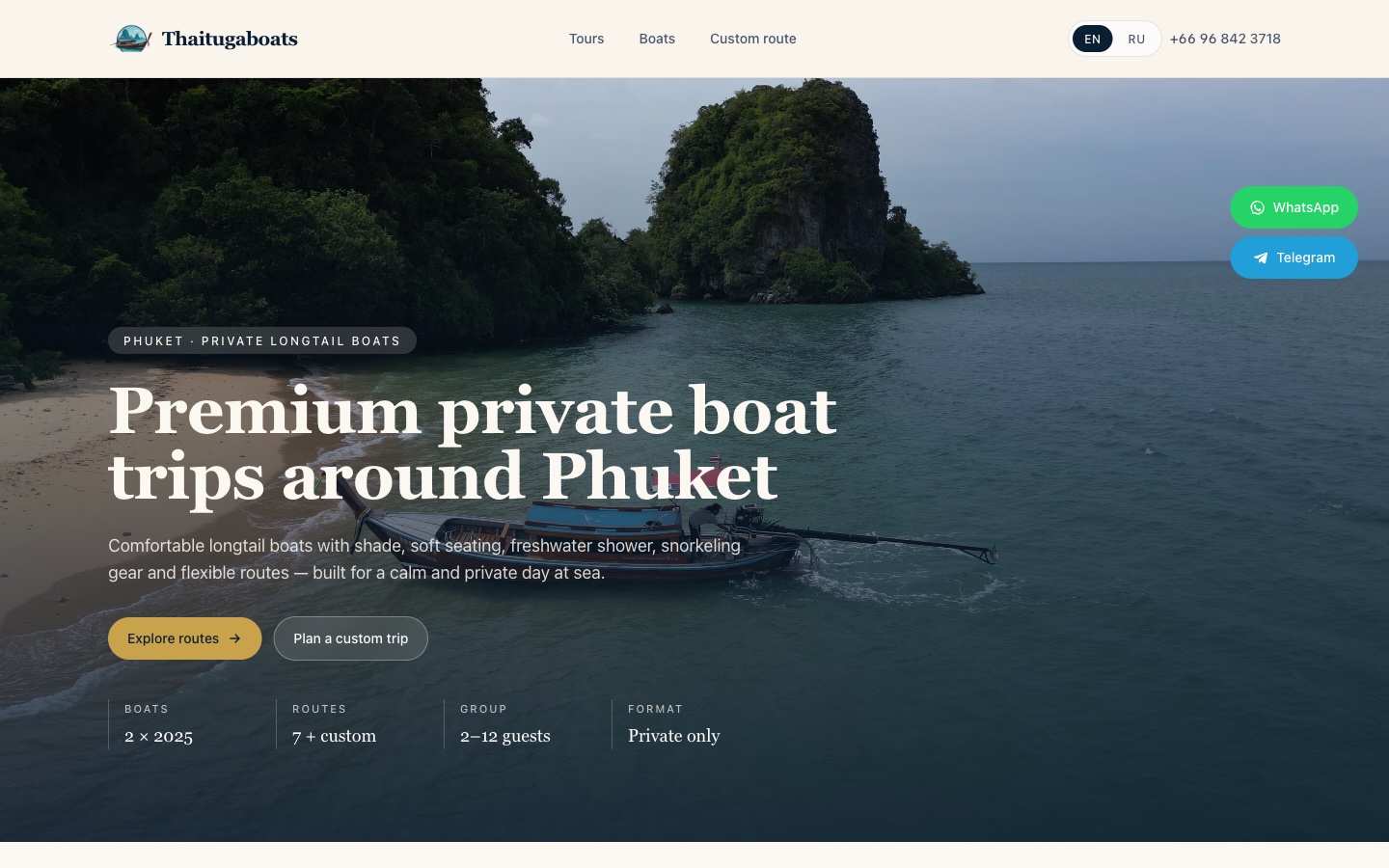
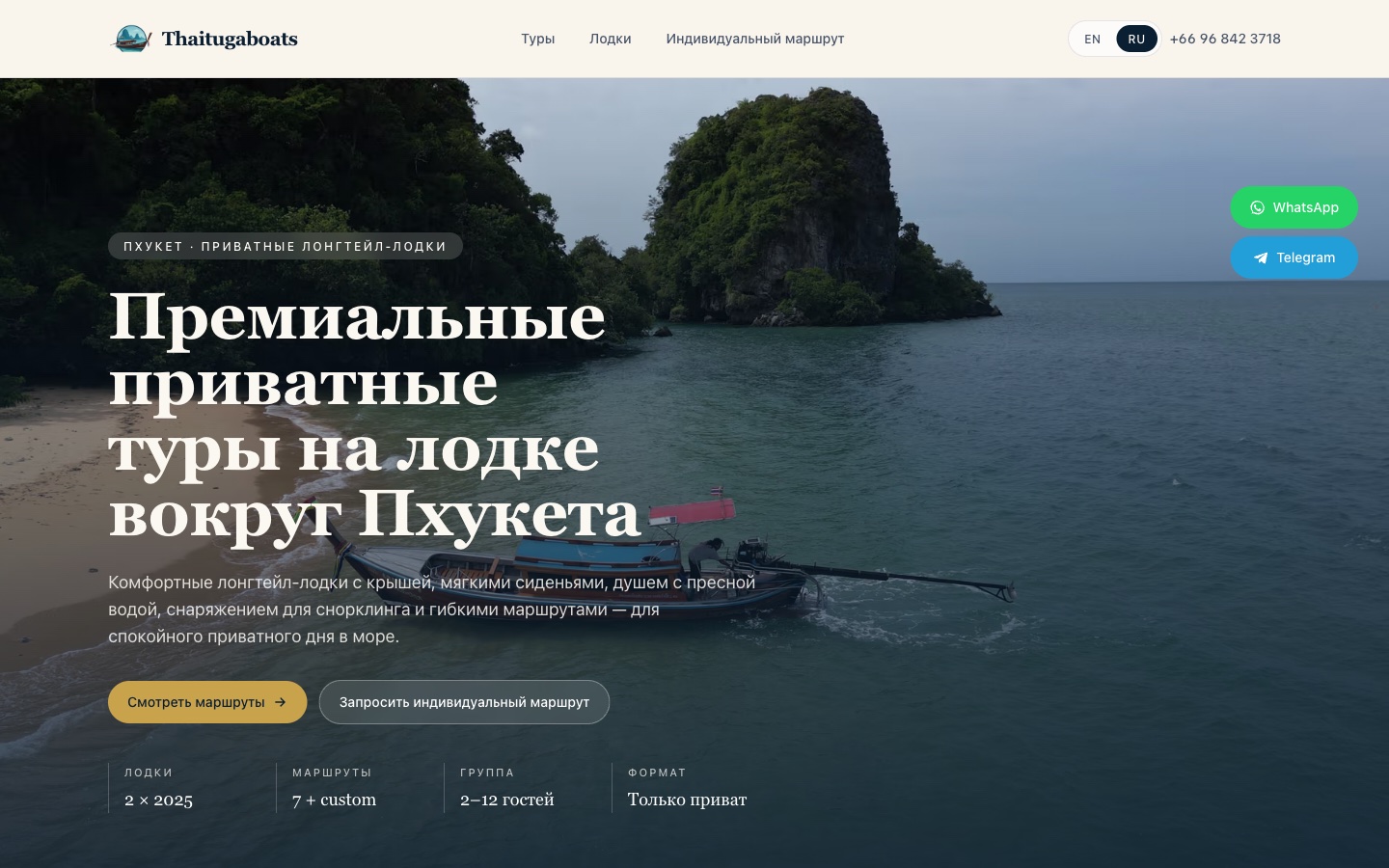
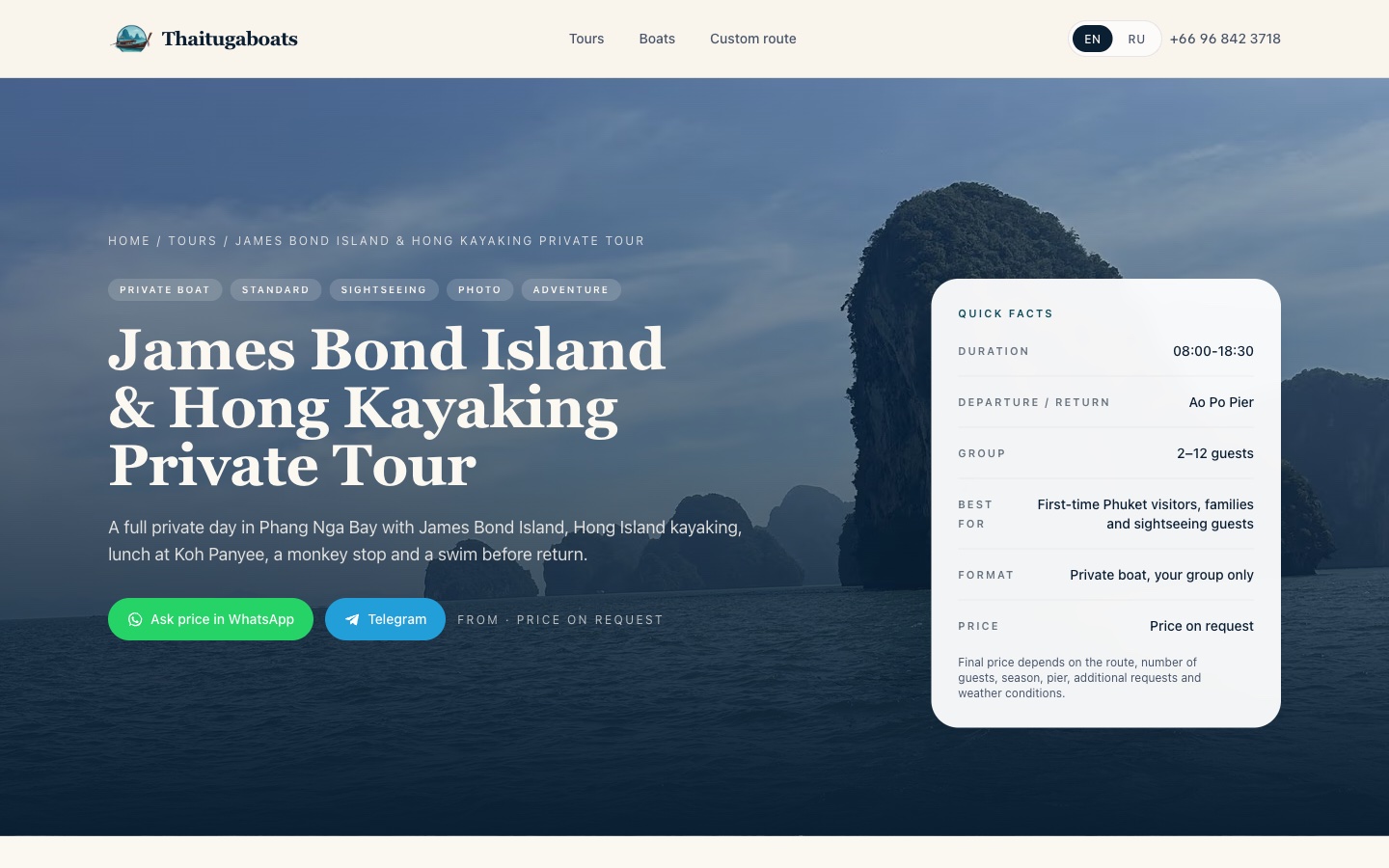
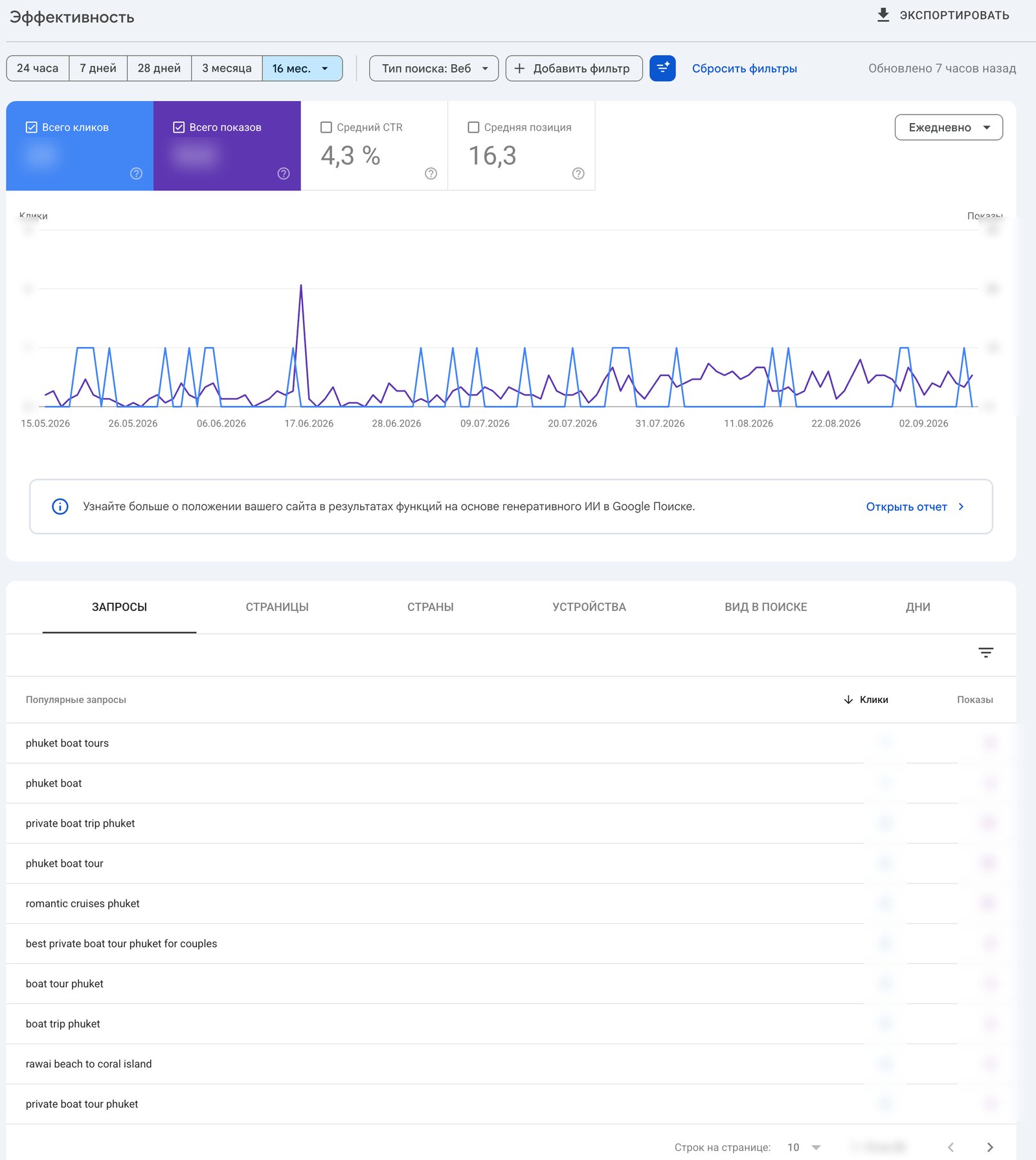
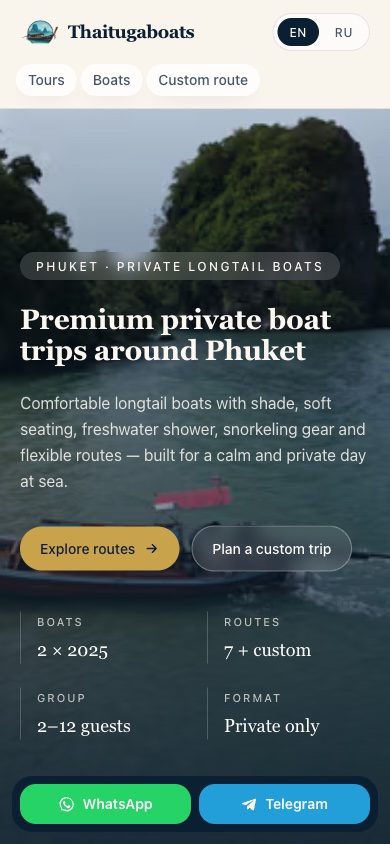
The result: targeted clicks from Google in the very first season
The site launched in early May 2026 and has run without interruption since: pages are served from the Cloudflare cache in tens of milliseconds, and Lighthouse scores SEO and best practices at 100 out of 100. But the main thing is search: for a new domain with no history and no link building, Google impressions grew about 3x in four months, CTR is 4.3%, and the average position across all queries is 16, the second page of results. The top ten queries that bring people in are all on target: "private boat tour phuket", "phuket boat tours", "romantic cruises phuket". All of this comes from structure, copy, markup and speed alone, before any work on content and links.
Checklist: seven questions for a website with guests from different countries
Open the page code and look for hreflang. If it's missing, Google decides on its own which version to show, and often gets it wrong.
In the first line of code, an English page should have lang="en" and a Russian page lang="ru". Bilingual sites most often have one language set for all pages.
If the site is behind Cloudflare, the server response should include cf-cache-status: HIT. DYNAMIC means every page travels from your server, wherever the guest is.
Open it on its own. Over 300 KB, or JPEG instead of AVIF and WebP, and the site loads slower than it could, especially over mobile internet.
Check the page in Google's Rich Results Test: it should find the service type, a price or "on request", and an FAQ block.
Is it private, how much does it cost, how many people, can kids come, what is included. AI assistants use these same answers in their recommendations.
If not, you don't know which pages bring in guests, and you can't improve the site based on data rather than gut feeling.